If any of us went out and bought a 1977-1981 Buick or Cadillac, we wouldn't think of taking it out on the road and pushing it to 80 or 100 mph with the original old tires on it, would we? Stainless steel, used for components such as rigging wire, chain plates, and most bolts aboard, is somewhat like rubber, in that it can and does degrade; rubber via sunlight, stainless steel via water/deoxygenated water. It doesn't mater if your eyes spot the fine cracks, the wetted material degenerates.
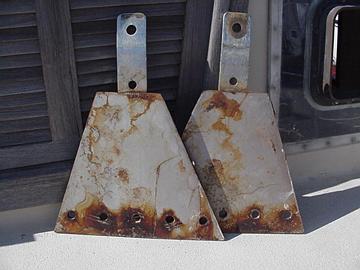
Rust on an interior chain plate, is a sign of water intrusion through or around the cap rail. It's difficult to determine the extent of damage by the rusting discoloration of the surface. It is known that water has seeped into the hulls around these plates on most boats. If the discoloration is there, that is the proof. After 30 years, it seems advisable to remove and replace them, just as one would do with old tires. The CSY is lucky to have reasonable accessability to the plates, so this project makes the CSY's lifespan extendable more than many or most boats out there.
Rigging wires have a life of about 10 years or a circumnavigation due to the same processes of wetting and stress loading. Why would it be reasonable to think other stainless steel under similar loads or conditions would be different? (I don't know about yours, but my boat will be 31 next month.)
I only became suspect
 of stainless in the
  mid 90's and somewhat must thank the CSY Topica list for allowing the subject to get specific, linking the problem to chain plates. Years have passed and much has occurred to confirm that 'we' the owners of this quality sailboat, need to be aware of all the components that contribute to the safety of those who travel on or in it. As I have just mentioned, we would not think of driving a car on old cracked tires, so why would we consider our boats impervious to degradation of important parts. (rigging wires 10 years-chain plates and their bolts... 30???) This is NOT a CSY problem. It IS a boat problem...All boats. http://www.amarinesurveyor.com/chainplate.htm We are lucky though that as a group, we have discussed it and doing something about it. Many vessels do not have the advantage of our history of discussion/repair solutions, so we are ahead of the pack and safer for it. For some boat brands, this might not be a doable project so they ignore it. Those boats will soon be worthless.
Do not loose the concept that surveyors will not always pick up even, 'visable' problems. They sometimes(and I think I am being kind)seem to not speak of problems that will 'kill the deal'. They are limited to 'viewing' and cannot disassemble anything in their survey, so not uncovering all defects is the reasonable outcome. Even if you ask specific questions and 'get it in writing...' you should trust that Father Time has done his thing and CYA in budgeting for repairs and replacements.
I "Chose" to remove my chainplates before there was a problem. My personal solution was to me, a CSY 44 UPGRADE. After seeing a great chain plate design in Steve Dashew's Cruising Encyclopedia, page 582, I modified their concept a bit to adapt it to the 44' CSY hull and had 10 of them made. Cutters need 6, ketches need 10. (I now use 12 to enable me to rig the m
 izzen independently from the main without using a triadic stay- by adding forward intermediate stays from the mizzen instead). So far, 6-12 sets of circular plates have been made and installed on CSY 44's. Wide grip, easy fabrication(identical plates) and simple installation and external for many reasons.
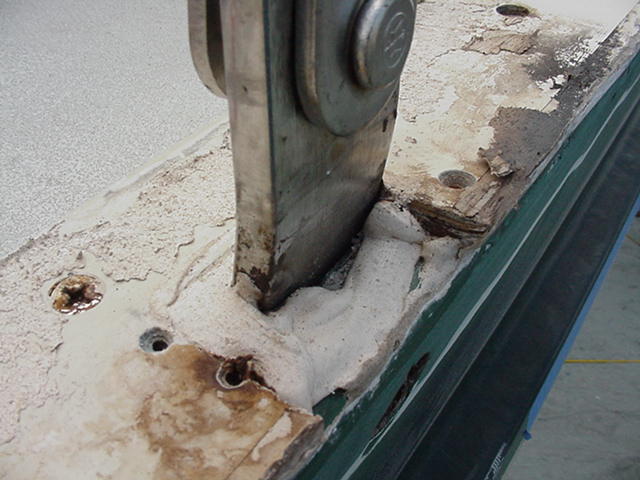
Bedding (original) around INTERNAL chain plate was poor. Gap shown here, of 1/4" x 1.5", allowed water to seap below decks. Rust stains on 52oo shows poor bonding and a place that water stagnated.
Photos included here are of the original CSY Triangular plates and are offered only to explain and show the 'obvious' problems. Stainless steel does not last forever and certainly does not 'IF' it is subjected to an Oxygen deprived environment, as "in a trapped area" below the teak cap rail. The bedding of the cap rail was done in such a way as to allow water to get below the cap rail and then run down hill to any opening into the hull, sometimes allowing water to drain to lockers or chain plates.
CSY chose to use 'Internal' chain plates. The chain plate then needs to have it's tang pass through the hull at deck level to attach to the rigging turnbuckles. It is at this point that caulking of some kind is needed and so doing, creates an area to entrap water. Even if only a drop or two, it will stagnate and become oxygen starved, eventually leading to crevise corrosion and stainless steel failure.

The main failure point seems to me to be the first hole below c
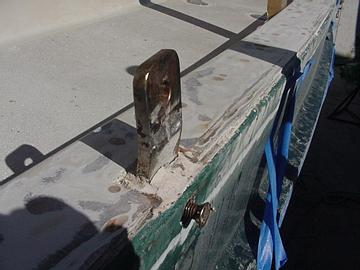 ap rail level and also the cap shroud the most common failure plate.
Failures seem to occur at or near this upper bolt hole as it is the weakest point, due to limits of material mass or weld, subjected to water degradation; then, stress from the rig. The 2" tang, is drilled for the 1/2" top mounting bolt; leaving (2) 3/4" segments of 3/8" stainless, just under the cap rail to get wet and develop 'crevice corrosion'. Add 30 years to the damp environment and rigging stresses and you get.........?
This 2" (now 1.5")drilled tang, is the weakest point of the chain plate. It's subject to crevice corrosion/and stress/it's bolt can be loosened by rigging pressure pulling it's top bolt's flat head inward thru the glass(poor fiberglass support). CSY's design of spreading the chain plate load over 5 lower bolts and only one for the top was going in the right direction in my opinion by spreading the grip over a wide area of glass, but the top bolt is being pulled inward esp. on the forward and aft lowers, which makes it subject to loosening it's grip on the hull and also allowing the upper seal to leak due to movement. That movement will eventually allow water to creep below. An external chain plate would not have had this problem and I opted for this as a fix for my boat.
The load on the "Tang" for the forward and aft lowers, is inward towards mast. The original flat head bolt up near the cap rail and under the 2" teak strip below the cap rail, gets pulled into hull at forward and aft lowers. This load can potentially allow enough movement to break a seal as the tang of the chain plate goes through to the rigs turnbuckle.
Some drawings and photos will be offered on alternative ideas demonstated by owners to aleviate the potential problem and make the chain plates 'Inspectable'.
Do NOT feel that the problem is a "CSY ONLY" problem. Aging stainless steel is a problem that ALL boats share. However, many CSY owners have addressed the issue and have solutions! Chain Plates: part 2 will cover some of them. Even after 30 years, a few projects will bring a rebuildable boat up to snuff.
For your interest: A few months ago I received an email from the editor of PACIFIC YACHTING/boating in the PACIFIC NORTHWEST, regarding my photos of CSY stainless chain plates and bolts . They did a decent write
 up on th
 e faults of Stainless Steel in the marine environ
 ment and used a few of my photos. The bottom line is not my photos, but that good magazines are addressing problems that "All boats of our vintage need to address. Deterioration of metals is a subject for required reading on ALL boats. "WE" are ahead of the others in discussion of solutions!